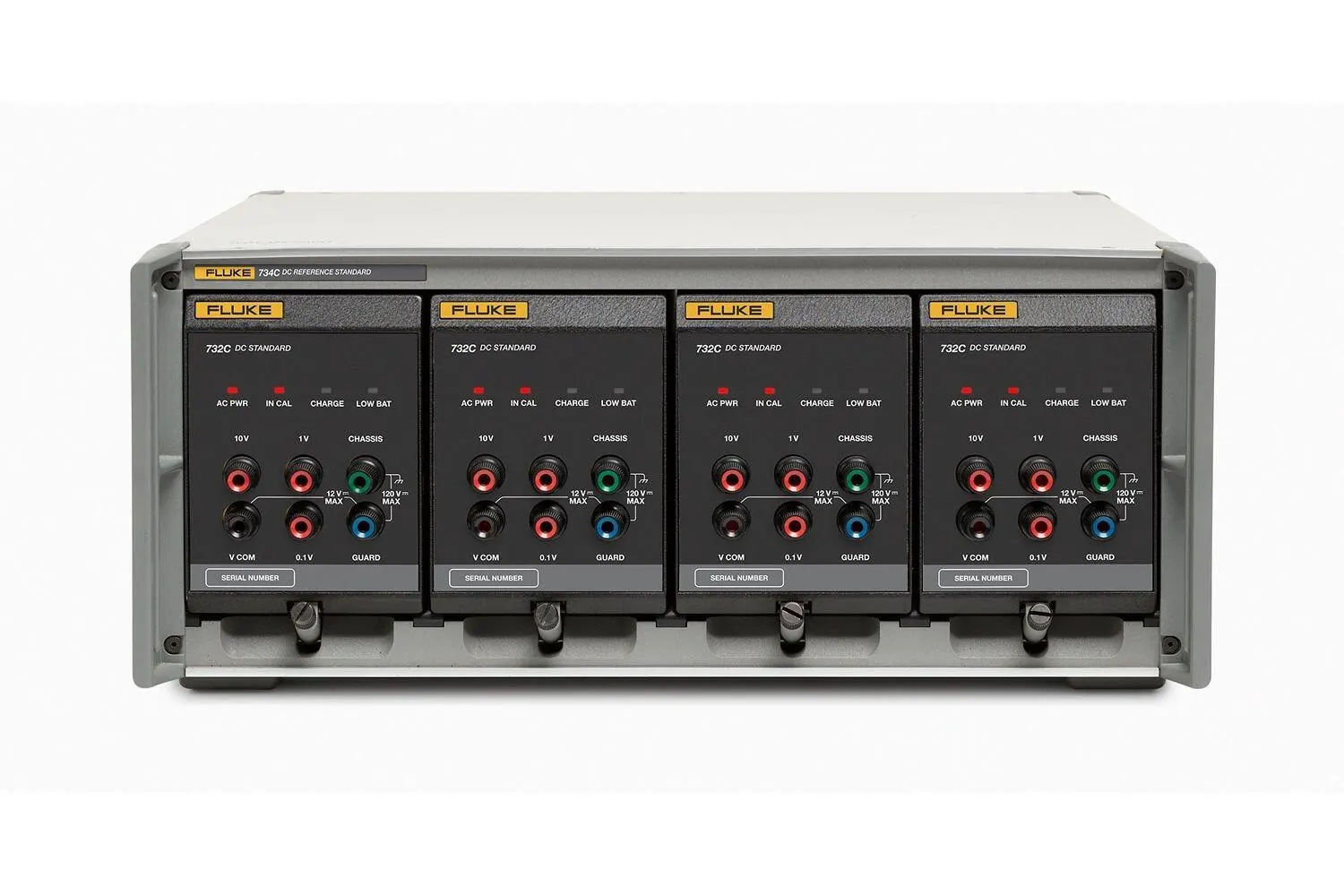
732C and 734C DC Voltage Reference Standards are high-performance metrology instruments designed to define the most accurate voltage values possible. RoHS compliant and ultra-stable, they serve as the foundation for voltage traceability in primary and secondary laboratories.
- Model 732C: A portable direct voltage standard providing outputs of 10 V, 1 V, and 0.1 V. Its rugged design makes it ideal for inter-laboratory transfers and on-site calibration.
- Model 734C: Consists of four electrically and mechanically independent 732C units. This configuration establishes a redundant reference system, allowing for internal validation and statistical averaging to lower uncertainty.
Key Features:
- Traceability: Fully traceable to the Fluke Josephson Array, ensuring absolute confidence in calibration results.
- Proven Long-Term Stability: Exceptionally low drift rates make these standards perfect for maintaining a constant voltage reference over time.
- 1 V and 0.1 V Outputs: Included as standard, these outputs utilize high-precision thin-film resistive networks manufactured by Fluke. This eliminates the need for external dividers, simplifying the calibration of digital multimeters (DMMs).
Performance Options:
- Select Models: For laboratories requiring even higher precision, “Select” models (732C/S/C or 734C/S/04) are available. These units offer 2x better stability at 10 V compared to the base models, ideal for rigorous workloads or increased independence from external calibration.
Shipping & Traceability:
- COLD Shipment (Base Model): Shipped powered off. The owner is responsible for establishing traceability upon receipt.
- HOT Shipment (Certified): Shipped powered on with continuous battery operation. Includes an Accredited Calibration certificate traceable to Fluke’s standards. Note: Continuous power must be maintained during transit for the certificate to remain valid.
Why Choose the 4-Unit 734C System? According to NBS Technical Note 1239, 4 to 6 independent references are required to ensure integrity and reduce correlation errors. The 734C meets this requirement by housing four completely independent 732C units—each with its own power supply, oven, electronics, and shielding.
- Redundancy: Compare three units regularly to detect drift, while using the fourth as a backup or for transport to a National Lab without disrupting your local reference.
- Reduced Uncertainty: By averaging the four units, you can reduce uncertainty by up to 3 times. Fluke’s own Primary Standards Laboratory used this method to achieve an absolute uncertainty of ±0.35 µV/V before the adoption of Josephson Arrays.
The Fluke Advantage:
- Independence: The only standard of its kind offering total mechanical and electrical isolation between the four units.
- Portability: Designed to be small, lightweight, and rugged with long battery life for safe transport.
- Confidence: Built on the legacy of the 732A—the first electronic reference widely accepted to replace saturated standard cells.